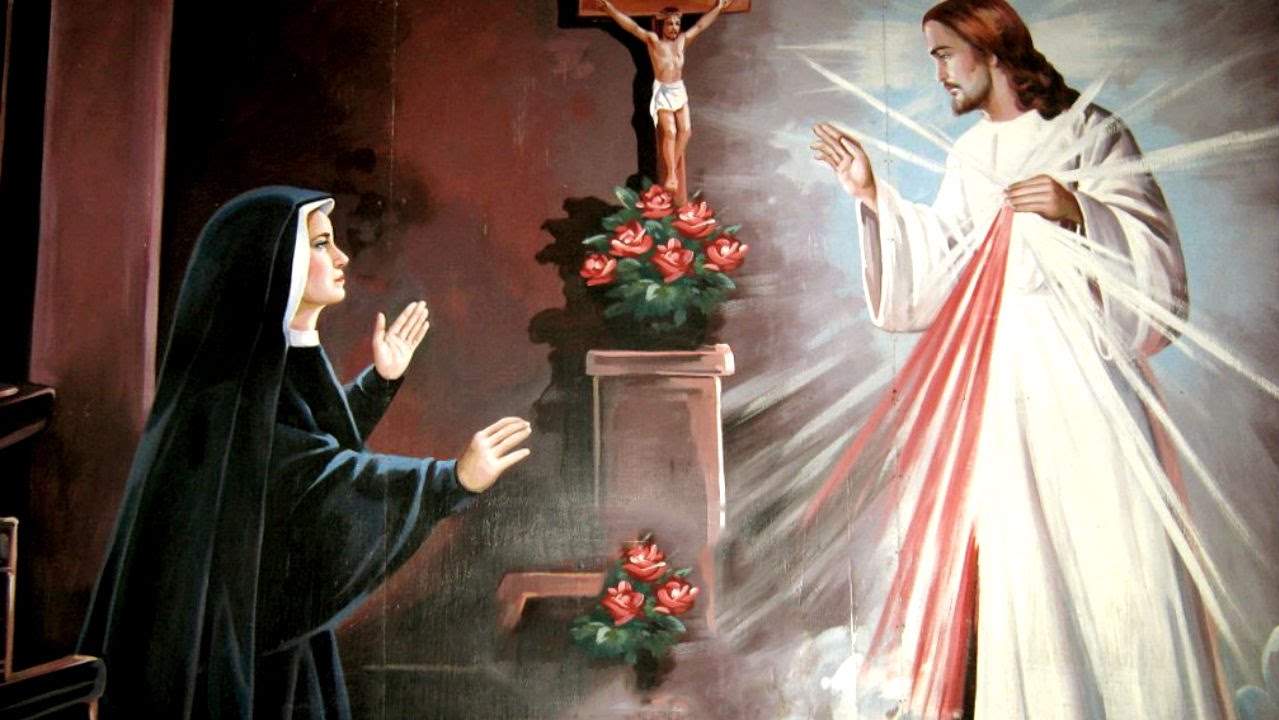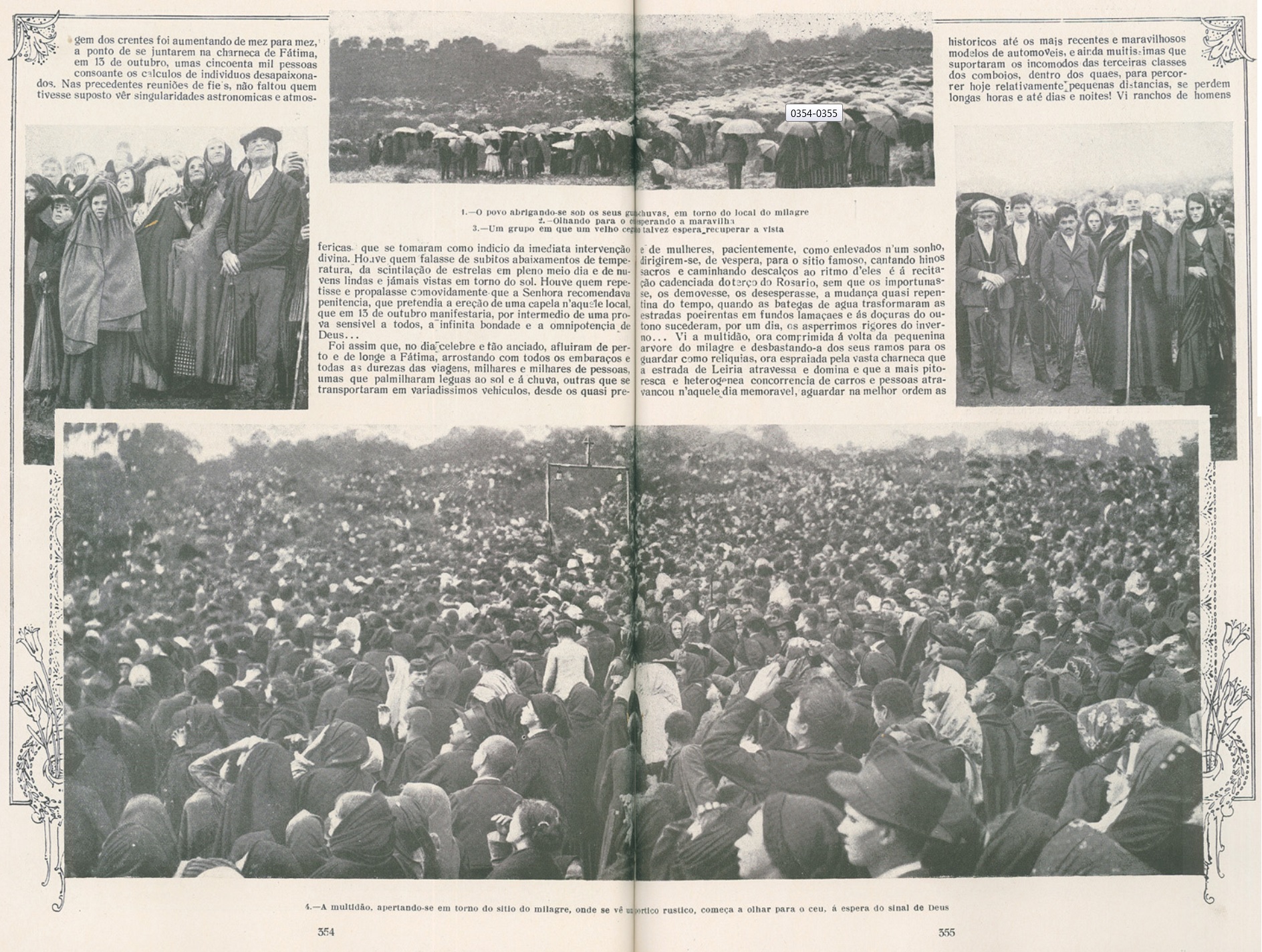

In 1917, on the 13th day of each month for six months starting in May, the Blessed Virgin Mary appeared to three children in Fatima, Portugal. The apparitions at Fatima have particular significance regarding the rosary as Mary asked the children to pray it every day informing them it was the key to peace both personally and globally. Fatima is where we also get the Fatima Prayer which is prayed at the end of each decade of the rosary. For those who do not know it, it is very simple and yet extremely powerful:
O my Jesus, forgive us our sins, save us from the fires of hell and lead all souls to heaven, especially those in most need of your mercy.
There is so much power contained in that one little sentence. As I explain in my upcoming book on the rosary (that’s right, I’m writing a book), this is an incredibly important prayer since you acknowledge the reality of hell and that everyone runs the risk of going there if we choose to live in sin instead of embracing God’s truth. We beg for God’s mercy that we will be worthy of Heaven and ask for mercy for those who do not live as Jesus calls them. Take this small prayer seriously as it reminds us of the consequences of sin and the power of God to forgive and save anyone no matter how far they may stray.
If you do not know much about Fatima, I encourage you to take some time reading about it as it is really fascinating and also slightly scary. You can get a good overview from Wikipedia, Catholic Exchange, or any number of books and DVDs from Amazon.
The Gospel for Sunday, May 8 is from Luke 24:13-35 where some disciples of Jesus met Him on the road to Jerusalem but did not recognize Him. They did not realize Jesus was with them until He ate with them and broke bread similar to what He did at the Last Supper. Only then did they realize how foolish they were that they did not recognize Jesus in their presence. Likewise, when we pray the rosary Jesus is in our presence both listening to us and trying to guide us to His kingdom of Heaven. But often we do not recognize Jesus’ presence in our prayers or in our lives.
This Sunday’s Gospel follows the same theme as last week’s in that it shows that all too often we look for God in our lives in all the wrong places. Last week Thomas the apostle had so little faith he would not recognize Jesus’ resurrection until he saw Jesus face to face. And now in this week’s Gospel two of Jesus’ disciples did not recognize Jesus although they were walking and talking with Him. They did not see Jesus despite the fact that He explained all the scriptures and the teachings of the prophets explaining His death and resurrection. And yet they still did not recognize Him. We too often fail to recognize Jesus in our lives although His truth is all around us.
I touched on this briefly when discussing Doubting Thomas and how we do not always take those telling the truth seriously. In this case I mean the truth of Jesus Christ as taught through the Catholic Church. We hear this truth all the time whether it be during Mass, in the Catechism or Bible, Papal decrees, or simply the Church’s traditions that have been practiced for centuries. We hear them and yet we so often do not follow them because we do not think of them as Jesus’ teachings. We hear them as the thoughts and opinions of fellow humans much like the disciples in the Gospel thought that Jesus was just some normal traveler. And so we do not give the Church’s teachings the consideration they deserve and go about living counter to its teachings. Would you argue about abortion, euthanasia, embryonic stem cell research, contraception, and human cloning if you stood face to face with Jesus? Probably not. So why do we so readily argue with His Church and disobey His teachings? Are we like the disciples in the Gospel who discovered how foolish they were for not recognizing Jesus in their presence?
We should remember this Gospel reading when we pray the Third Luminous Mystery of the rosary and remember Jesus’ proclamation of Heaven and His call to conversion. Really meditate this week on the areas in your life where you do not hear Jesus through the Church’s teachings and challenge yourself to learn what Jesus is trying to tell you through His Church. You will probably not be converted in some of your beliefs overnight. But just researching what the Church really believes and teaches and humbling yourself to the possibility that there might be areas of your life where you have not let the Holy Spirit guide you is a huge step in the right direction. There is no doubt that questioning your deeply held beliefs is hard especially if Jesus leads you in a direction that runs counter to popular opinion. But the Third Luminous Mystery points out that we need to choose whether to live for God’s kingdom or our earthly kingdom. Do you see that Jesus walks beside you every day and is trying to lead you down the right path or are you too wrapped up in living solely for what this world has to offer?
Our Lady’s message of April 2, 2011 to Mirjana at Medjugore
Dear children; With motherly love I desire to open the heart of each of you and to teach you personal unity with the Father. To accept this, you must comprehend that you are important to God and that He is calling you individually. You must comprehend that your prayer is a conversation of a child with the Father; that love is the way by which you must set out – love for God and for your neighbour. That is, my children, the love that has no boundaries, that is the love that emanates from truth and goes to the end. Follow me, my children, so that also others, in recognizing the truth and love in you, may follow you. Thank you.
I like that Mary tells us that prayer is our conversation with God. We so often rattle off prayers that we forget the point of them. Prayers are not some sort of divine credit where you get a certain amount of points each time your pray. A lot of people think of prayer this way. On Catholic message forums I read posts from people always asking questions like, “Why did I get this illness although I pray every day?” We must remember that Jesus never said, nor does the Church teach that misfortune will never befall those who pray. In fact, the history of the Catholic Church seems to show quite the opposite. Usually the saints and other faithful people led challenging lives and were often persecuted or martyred.
Image by Lel4nd via Flickr
Instead of viewing prayer as some sort of spritual ATM, we must think of it more as our opportunity to voice or concerns and thanksgivings to God. But almost more importantly, we must take that time to listen to what God tells us. The true power of prayer is not that God will make our lives easy but that He will give us strength and guidance when difficult times hit us. Furthermore, we have powerful prayers like the rosary. The mysteries of the rosary and the structure of its prayers provide a framework for conversing with God. Think of it as a way of speaking God’s language and making you more receptive and more likely to understand what God tells you.
Our Lady’s message of April 25, 2011 at Medjugorje
Dear children! As nature gives the most beautiful colors of the year, I also call you to witness with your life and to help others to draw closer to my Immaculate Heart, so that the flame of love for the Most High may sprout in their hearts. I am with you and I unceasingly pray for you that your life may be a reflection of Heaven here on earth. Thank you for having responded to my call.
Image via Wikipedia
Mary asks us to not to pay lip service to our faith through a lot of empty words and promises. Rather, she wants us to live our faith with every word we speak, every thought in our mind, and every action we make. She calls us to live in constant prayer so that we may be a beacon of Jesus’ love to all those around us.
We should remember Mary’s message when we pray the Second Joyful Mystery of the rosary — The Visitation. Mary, after having accepted God’s Will in The Annunciation traveled to see her cousin, Elizabeth. In the Gospel, these events happen side by side for a reason. The first thing that Mary does after receiving God’s grace is go out and share the good news with others. She did not keep that grace bottled up nor did she brag about God having chosen her to bring Jesus into this world. Similarly, Mary calls us to not keep our faith bottled up. Rather, she wants us to go out and be a reflection of Jesus’ love to all those around us. When you meditate on the Visitation while praying the rosary ask yourself, “are my actions an accurate reflection of Jesus’ love?”
The Gospel for May 1, 2011 is from John 20:19-31 where Jesus appears to His apostles after rising from the dead. Thomas, who was not there when Jesus appeared, did not believe the apostles’ claim since he had not seen Jesus personally. This Gospel teaches the meaning and value of faith and how we are often like doubting Thomas where we do not see the wonderful works of Jesus in our lives. Like the Second Luminous Mystery of the rosary, the Miracle at Cana, Jesus performs miracles all around us every day and yet we often overlook them.
When you pray the rosary think about spending some time thanking God for all He does for He performs both small and large miracles every day. At Cana, Jesus turned water into wine. But that seems almost trivial when you consider the miracle of your life. Just the fact that you are alive is miracle enough. After all, you came from nothingness, started life as a little group of cells, and are now a moving, breathing human being with the ability to spread so much joy and happiness in others’ lives. Throw on top of that the friends and family God placed in your life. If you are married, think about the fact that out of the billions of the people in the world and the centuries of human existence God placed you and your spouse together at this specific place and time. Think about all the skills you posses whether they be physical or mental. We should remember to thank God for even the small miracles of a sunny day or a comfortable bed to sleep in at night.
Despite all the miracles around us we act like Thomas in John’s Gospel. Thomas needed to personally experience that BIG MIRACLE to believe in Christ’s resurrection. He would not take others’ word for it. We too often look only for only that big miracle in our life to truly believe and love Jesus. We want the booming voice from the sky to speak to us. We want to see a hand reach down from the clouds to prevent an almost certain disaster. We want our prayers to win the lottery answered. Unfortunately, we are often so blinded looking for that big miracle that we overlook all those other miracles that show God’s presence in our lives. Like Thomas not believing the word of the other apostles, we often ignore or do not believe the teachings of the Catholic Church. The message of the Gospel and the Second Luminous Mystery is to have faith and rejoice in EVERYTHING God does for us and not be disappointed because He does not perform a specific, big miracle.
The Easter Gospel is either from John 20:1-9 or Matthew 28:1-10. Both talk about how Mary Magdalene came to Jesus’ tomb only to find it empty for He had risen. Naturally this Gospel relates to the First Glorious Mystery — Jesus’ Resurrection. Realizing the sorrow of Jesus’s passion and death only makes His resurrection that much more joyful. For while Jesus’ earthly life ended in great suffering and sorrow He rose to His eternal, heavenly life in glory. We too should remember that in our greatest sorrows and suffering we are called to one day rise to new life in the eternal joy of God’s heavenly kingdom.
The Palm Sunday Gospel for April 17, 2011 covers the Last Supper, the Agony in the Garden, and Jesus’ Passion and death (Matthew 26:14-27). This Gospel covers all the Sorrowful Mysteries of the rosary. There is just so much in this Gospel it is almost a shame that we read it all at once instead of breaking it up over several Masses. But just because you read the Gospel straight through during Mass does not mean you cannot meditate more on it yourself. Take your time in this last week leading up to Easter to really absorb the central themes behind the Sorrowful Mysteries of the rosary. Meditate on Christ’s Passion and death and thank Him for all he does for us.
I know that many times we walk into the church on Palm Sunday and it hits us that this is that LONG Mass and we develop a bitterness because the Mass might run longer than an hour. Try not to think about how long the Mass is or how it seems to upset your plans for the day. That extra time should be seen as a gift, not a burden. Use that time to focus on all Jesus does for us and what He asks us to live. Jesus sacrificed His life for us so the least we can do is spend a few extra minutes with Him in prayer.
I encourage you to read my postings on the Sorrowful Mysteries throughout this week. Think about the quantity and quality of your prayers when you read the First Sorrowful Mystery — The Agony in the Garden. Pray for all those who suffer, especially those who suffer because they strayed from God’s path, when meditating on Jesus’ Scourging in the Second Sorrowful Mystery. Ask yourself how much respect you give to Jesus and His Church in the Third Sorrowful Mystery — The Crowning of Thorns. Look around at the crosses other bare and see if you can help them any way you can when you think of Jesus taking up His cross in the Fourth Sorrowful Mystery. And finally, follow Jesus’ example in His crucifixion and ask God for the strength to do His Will no matter where that takes you.
Make the most of Holy Week. Do not treat it like every other week of the year but really make an effort to turn it into a time of more intense prayer and meditation. God Bless!
The Gospel for April 10, 2011 is John 11:1-45. In this Gospel, Jesus performs the miracle of raising His friend, Lazarus, from the dead. This Gospel foreshadows Jesus’ resurrection which we pray in the First Glorious Mystery of the rosary. Both this rosary mystery and the Gospel remind us that there is more to our existence than this earthly life. God’s divine plan for all of us does not end with the death of our physical bodies. His plan also includes our souls living for all eternity in His heavenly kingdom.
News flash, we all have a terminal illness. I do not want to be a downer, but we all had this illness from the we were conceived. Our terminal condition is our earthly existence. No one will physically live forever. But we should not despair as Jesus said this in the Gospel:
This illness is not to end in death, but is for the glory of God, that the Son of God may be glorified through it.
While Jesus was referring to Lazarus, He might as well have spoken about the human condition and our mortality. None of our lives will end in death if we define death to be a transition to nothingness. Instead our souls will live for all eternity. We should recognize that reality and adjust our lives by avoiding sin and doing good works.
In addition to our final, physical death we also encounter little deaths throughout our lives. I refer to the death of our relationship with God when we commit mortal sin. When we sever ourselves from God’s grace our soul experiences a type of spiritual death. However, like how Jesus physically raised Lazarus from the dead, the Holy Spirit raises our soul from its death through the Sacrament of Reconciliation. Our return to God’s grace is just as miraculous, and I would say vastly more important, as if Jesus raised us physically from the dead as He did with Lazarus. Especially in this period of Lent, it is so critically important to do a little spiritual spring cleaning of our souls and go to confession. We all should experience the miracle of God rising our souls from their spiritual sleep. And we must pray for all those in this world who are spiritually dead through sin that they have the courage and humility to return to God’s grace.
In this Gospel reading Lazarus’ rise from the dead foreshadows Jesus’ resurrection. We remember Jesus’ resurrection in the First Glorious Mystery of the rosary. One of the central themes of this mystery is that our physical death is not the end of us. Rather, it is just the beginning of a new life either in Heaven or in Hell. I believe that our spiritual life is actually our real life as it is eternal. Our life here on earth, even if we live one hundred or more years, is nothing compared to eternity. So which existence is really the one where we live as our true self? Our current, temporary, and imperfect life or the eternal existence in the afterlife? When we pray the rosary, think about this Gospel, and meditate on Jesus’ resurrection may we remember to make the most of this short time we have in this life by being a testament to the glory of God. God desires all of us to be with Him in Heaven. Through Jesus’ resurrection, He showed us that there is so much more to our existence than what we experience in this world. Let us not become so obsessed and consumed by all the material wants of this life as they will all one day disappear. Instead, we should pray that we can endure and reject the temptations of this world and live for the greater goal of an eternity of joy and happiness in Heaven.
The Gospel for April 3, 2011 is John 9:1-41 (yep, it is a long one). Jesus angers the pharisees by healing a blind man on the Sabbath. The high priests are outraged because they see Jesus as someone who undermines their authority and performs miracles without their approval. But Jesus says that He came to open the eyes of the spiritually blind while also blinding those who see through a lens of self-righteousness like the pharisees. We remember in The Second Glorious Mystery of the rosary, The Ascension, that Jesus will one day judge us and so we must not be blind to His teachings.
The pharisees question nearly all of Jesus’ miracles throughout the Gospel and the healing of the blind man is no different. They throw out the usual accusations — Jesus must derive His power from Satan or that He is not sent from God since He disobeys the Mosaic laws. Each time the pharisees question Jesus they end up embarrassing themselves as Jesus points out the flaws to their blind adherence to the Mosaic Law. You would think they would have learned their lesson the first couple of times Jesus set them straight. By interrogating the blind man, his family, and Jesus we get a sense of the pharisees’ growing frustration with Jesus since He threatens their authority. Like modern-day politicians, the pharisees’ goal is not to show God’s truth but keep as much earthly power as possible.
Jesus’ response to the pharisees’ criticism is found in verses 39-41:
Then Jesus said, “I came into this world for judgment, so that those who do not see might see, and those who do see might become blind.” Some of the Pharisees who were with him heard this and said to him, “Surely we are not also blind, are we?” Jesus said to them, “If you were blind, you would have no sin; but now you are saying, ‘We see,’ so your sin remains.
We see like the phariseesin that we know the truth of Jesus’ divine nature. We know Jesus’ will through the teachings and traditions of the Church, the Bible, in prayer, and the natural law written on each of our hearts. God gave us the law through Moses and completed that law through Jesus Christ. And yet, despite making His will known to us we often disobey Him through sin. As Jesus implies in the Gospel, our sin remains because we can see the difference between right and wrong but we choose to sin anyway. We look at the silliness of the great lengths the pharisees went to to discredit Jesus. And yet we too go through great lengths to sidestep living according to Jesus’ teachings. If you think about all that Jesus, the saints, and prophets have revealed to us about God’s will we also look very silly when we choose to sin in the face of all that knowledge.
We often take a self-righteous view of ourselves and believe that God approves of all that we do in life. Like the pharisees, we holler and yell when the Church tells us that our world view conflicts the truth of Jesus Christ. We shout, “How dare you say abortion is evil!” Or, “The Church’s teachings are so out of touch regarding premarital sex!” To many, the idea that we must humble ourselves and ask for forgiveness through the Sacrament of Reconciliation seems draconian. No one likes being told they are wrong or punished for bad behavior. But instead of avoiding bad behavior we seem to go out of our way to redefine what is bad and what is good. We try very hard to make God conform to our worldview instead of changing our worldview to fit God’s plan. Do we see that we are like the pharisees in the Gospel when we argue and rebel against God’s teachings instead of embracing them?
Jesus said in the Gospel that He came into this world for judgement. We remember Jesus’ coming judgement when we pray the Second Glorious Mystery. He ascended into Heaven to judge the living and the dead. Jesus will judge us based on His divine law. That judgement may be harsh since we have knowledge of His laws and yet chose not to follow Him. Remember, because we can see God’s truth, our sins remain. God will not care whether something was legal in some worldly court. He does not care about popular opinion. And so, an important goal in life should be following God’s laws because in the end, that is how He will judge us. When you pray the Second Glorious Mystery of the rosary acknowledge that we are all subject to God’s judgement one day. And may that knowledge translate into the courage to live according to God’s will by avoiding sin. Pray that we can humble ourselves and admit when we do stray from God’s path and embrace the Sacrament of Reconciliation, especially in this period of Lent.
Dear children; My motherly heart suffers tremendously as I look at my children who persistently put what is human before what is of God; at my children who, despite everything that surrounds them and despite all the signs that are sent to them, think that they can walk without my Son. They cannot! They are walking to eternal perdition. That is why I am gathering you, who are ready to open your heart to me, you who are ready to be apostles of my love, to help me; so that by living God’s love you may be an example to those who do not know it. May fasting and prayer give you strength in that and I bless you with motherly blessing in the name of the Father and of the Son and of the Holy Spirit. Thank you.
Image via Wikipedia
Mary’s message fits right in with the March 27, 2011 Gospel reading. I discussed how in that reading Jesus contrasts our worldly needs and wants against our spiritual needs. And here Mary tells us how she suffers tremendously when she sees us put our human wants in front of God. None of us want to upset our earthly mothers by behaving badly. Similarly, we don’t want to disappoint our Heavenly mother, Mary, by not living for the kingdom of Heaven. We should remember her words when we pray the Fourth Glorious Mystery of the rosary that Mary is our Heavenly mother who is there to help us find God’s grace. We need to listen to our mother by praying and fasting like she asks.
The Annual Apparition of Our Lady to Mirjana Dragicevic-Soldo on March 18, 2011
Dear children! I am with you in the name of the greatest Love, in the name of dear God, who has come close to you through my Son and has shown you real love. I desire to lead you on the way of God. I desire to teach you real love so that others may see it in you, that you may see it in others, that you may be a brother to them and that others may see a merciful brother in you. My children, do not be afraid to open your hearts to me. With motherly love, I will show you what I expect of each of you, what I expect of my apostles. Set out with me. Thank you.
We do not make our faith journey alone. In her message, Mary says that she is with us every step of the way. She has the desire to lead us into God’s graces. We not only have her help, but also the help of the Holy Spirit, angels, saints, and the entire Church. We have a tremendous amount assistance in our corner. But what they cannot give us is that desire to live in God’s love. Each of us has to make that decision to want to have a relationship with God. From that spark, Mary, the angels, and saints of Heaven can turn that spark into a fire of grace, joy, and happiness. Let us remember Mary, Queen of Heaven, is there for us when we pray the Fifth Glorious Mystery of the rosary.
Message, 25. March 2011
Dear children! In a special way today I desire to call you to conversion. As of today, may new life begin in your heart. Children, I desire to see your ‘yes’, and may your life be a joyful living of God’s will at every moment of your life. In a special way today, I bless you with my motherly blessing of peace, love and unity in my heart and in the heart of my Son Jesus. Thank you for having responded to my call.
Image via Wikipedia
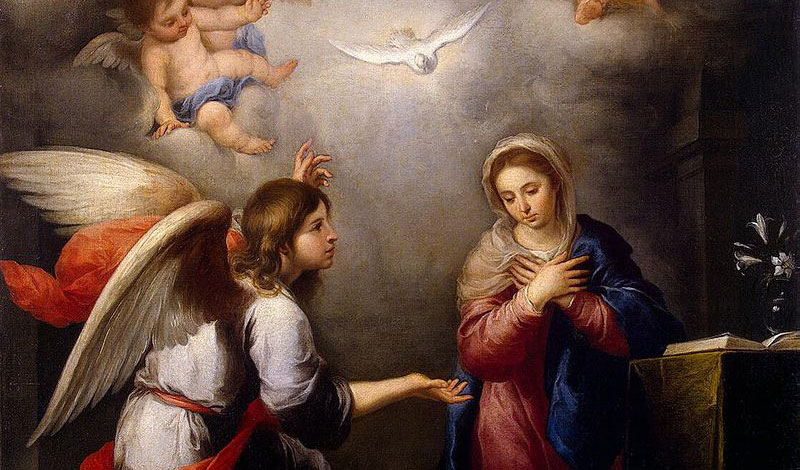
What does Mary mean by having a desire to see our yes? Remember, March 25 is the feast day of the Annunciation which we remember when we pray the First Joyful Mystery of the rosary. That was when Mary said yes to God to being the mother of Jesus Christ. The Annunciation marks the start of Jesus’ church on earth with a woman having the courage to say yes to God’s incredible request. And so it is fitting that Mary asks us to commit to conversion. She wants us to step out of our worldly comfort zone and take a chance living for Jesus’ heavenly kingdom. As she says in her other messages, Mary will be there to guide us and comfort us when we do commit to living as God asks. Mary received the ultimate blessing in the Annunciation when she said yes to God. All she desires is to see us receive God’s grace by making the same decision.
The Gospel for March 27, 2011 is from John 4:5-42 where Jesus encounters a Samaritan woman at a well. Jesus talks about how He offers water from which someone will never thirst and He has food the world has never known. One interpretation of Jesus’ words is that He is talking about His body and blood found in the Eucharist which we pray about in the Fifth Luminous Mystery of the rosary. The Eucharist provides us spiritual energy so that we have the power to focus on what should be the goal of our lives — to one day live in eternal happiness in Heaven.
Jesus compares physical bread and water to spiritual ones. He explains that when people consume physical bread and water they will be hungry and thirsty again. But spiritual bread and water are eternally sustaining. But Jesus is not just talking about being hungry or thirsty. Jesus essentially compares all our physical wants and needs against our spiritual ones. It is too often that we tend to focus on our physical needs and neglect our spiritual side. For example, many of us spend so much time and energy handling finances, world events, politics, social problems, family issues, and work anxieties. But how often do we focus on our relationship with God? Do we only give Him one hour a week at Mass if that? And yet, how much more important is our spiritual health considering that it will determine whether we will spend all eternity in the happiness of Heaven or suffer the misery of Hell? And even when we do focus on our spiritual needs, do we have the energy and courage to follow the Holy Spirit and do what is right?
Unfortunately, we often are not even putting our physical needs in front of our spiritual ones. More often, we put physical wants ahead of everything. We focus on our jobs and finances, not to provide for ourselves and our dependants, but for our wants. We work for iPods and iPads, expensive clothes, flat screen TVs, movies, and smart phones. And while none of these are inherently bad (we all need ways to relax), problems arise when we put those wants in front of our spiritual needs. Like the women in the Gospel who had five husbands, we often live in pursuit of moments of temporary happiness. We can probably picture this Samaritan woman choosing husbands for all the wrong reasons and getting involved with people mostly because they provided her with some short-term happiness. But like many things rooted in worldly happiness, they are shallow and it is not long before we crave something newer, different, and better.
In contrast to what this world can provide, Jesus offers us eternal happiness. But to obtain that we have to look past the temporary joys of this world even if that means temporary suffering. Unfortunately, many times we lose site of that long term goal of Heaven and settle for shallow, temporary happiness. Our challenge is to see past our temporary wants and live for eternal joy. After all, what’s 80, 90, or 100+ years of life compared to an eternity of love and happiness?
Life is basically a much longer and tougher Marshmallow Test. Watch the video below and notice how difficult it is for the children to forgo the smaller reward (one marshmallow) and wait for a larger one (two marshmallows). Yes it is humorous to watch and wonder why it is so difficult for kids to wait for a better reward. But as adults we really are not any better. Instead of marshmallows, we often settle for worldly happiness at the expense of eternal joy. We so easily accept what the world offers even when it goes against our faith. We do this because it makes our life easier, makes us popular, and avoids confrontation. It is amazing how we so easily throw away that grace through sin or just not putting a lot of effort into growing our spiritual endurance.
The Eucharist gives us the spiritual energy we need to live for the long term goal of eternal joy in God’s Heavenly kingdom. That is why we should receive it with a heart and mind focused on doing Jesus’ will. If we truly have the desire to live in God’s grace then the Holy Spirit will show us the way and the Eucharist will provide us the energy. When you pray The Fifth Luminous Mystery of the rosary meditate on this Sunday’s Gospel. Ask yourself, are you living for the temporary happiness of this world at the expense of eternal joy? This week and throughout Lent may we all pray for the strength to focus on what’s really important — living for God’s Kingdom of Heaven.